




















-
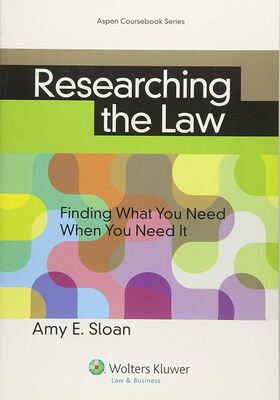
Researching the Law: Finding What You Need When You Need It, Fifth Edition
Amy E. Sloan
Researching the Law: Finding What You Need When You Need It, Fifth Edition guides students through a decidedly contemporary approach to legal research. Widely respected author Amy E. Sloan presents legal research as a process of efficiently filtering legal information to identify accurate and relevant content. Simply put, students learn how to locate and identify the most pertinent and authoritative information available with the greatest possible expedience. Sloan's clear, concise explanations of essential research sources are presented in a context that speaks to the way lawyers do research today, with a flexible approach that works in a rapidly changing research environment.
-
Using Generative AI for Legal Research, Third Edition
Amy E. Sloan
The promise of generative AI is awe-inspiring. Today, however, the questions about AI sometimes outnumber the answers. Using Generative AI for Legal Researchprovides a framework professors can use to introduce generative AI into the research curriculum.
To use AI effectively, researchers must be aware both of its potential and its limitations. Using Generative AI for Legal Research explores how AI fits within a process for conducting legal research. Specifically, this material:
- addresses advantages and challenges of using AI for research;
- outlines tasks for which AI is and is not useful;
- describes how to prompt AI tools to produce useful information;
- offers guidelines for citing and acknowledging AI-generated information.
The content follows the structure of chapters in in Basic Legal Research: Tools and Strategies (Revised 8th ed., 2024) and includes research examples and a chapter checklist. Although this material fits with Basic Legal Research, it can also be used as a stand-alone supplement with other instructional materials.
New to the Third Edition:
- Updated descriptions of different forms of AI
- Updated explanation of AI’s advantages and limitations, including strategies for avoiding research pitfalls
- New research examples highlighting how to evaluate AI research results
-
Using Generative AI for Legal Research, Second Edition
Amy E. Sloan
The promise of generative AI is awe-inspiring. Today, however, the questions about generative AI sometimes outnumber the answers. Using Generative AI for Legal Research, Second Edition provides a framework professors can use to introduce generative AI into the research curriculum. To use generative AI effectively, researchers must be aware both of its potential and its limitations. Using Generative AI for Legal Research explores how generative AI fits within a process for conducting legal research.
-
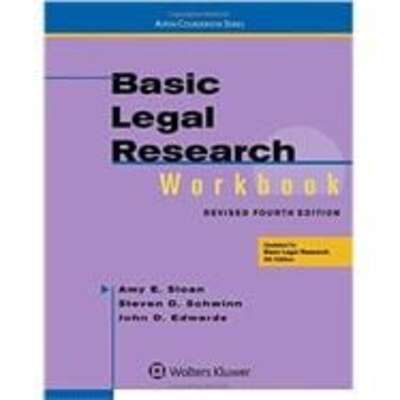
Basic Legal Research Workbook, Sixth Edition
Amy E. Sloan, Steven D. Schwinn, and John D. Edwards
A comprehensive companion to Basic Legal Research or comparable text, Basic Legal Research Workbook provides a well-chosen range of exercises and assignments to familiarize students with fundamental research sources. Logically and intuitively organized, BLR Workbook’s coverage mirrors the research sources studied in first-year Legal Research courses, with an emphasis on digital resources while retaining the option to utilize print sources. Research exercises are presented at graduated levels of difficulty, from guided research to open research requiring more advanced research skills. The digital research exercises progressively instruct students on the latest interface features of commonly used databases. Print options cover multiple jurisdictions, reducing the demand on single library sources. This Sixth edition retains all of the types of problems, formatting, and coverage that instructors have found helpful in prior editions, but with updating to reflect the most current digital resources.
-
Basic Legal Research: Tools and Strategies, Revised Eighth Edition
Amy E. Sloan
This best-selling coursebook on legal research is known for its clear, step-by-step instruction in the basics. Using a building-block approach, Basic Legal Research: Tools and Strategies, Revised Eighth Edition breaks material into discrete, readily comprehensible parts. Ideal as a course book or reference, this text emphasizes online research, with targeted coverage of print materials. Its comprehensive coverage and self-contained chapters offer flexibility to fit a variety of course structures. Useful pedagogy throughout the text includes end-of-chapter checklists, clear examples, and summary charts. Helpful sample pages and examples of research sources guide students through the presentation, and an accompanying workbook provides exercises to test comprehension and to apply legal research tools and strategies.
New to the Revised Eighth Edition:- New coverage of Westlaw Precision
- Coverage of the latest Shepard’s and KeyCite features
- New material on use of generative AI for legal research
Benefits for instructors and students:
- Clear, step-by-step instruction covering the basics of legal research
- A building-block approach that breaks the material into discrete and comprehensible parts
- Self-contained chapters on research sources that make the book adaptable to any type of legal research course
- End-of-chapter checklists, numerous examples, and summary charts that aid in understanding, retention, and review
-

Using Generative AI for Legal Research, First Edition
Amy E. Sloan
The promise of generative AI is awe-inspiring. Today, however, the questions about generative AI sometimes outnumber the answers. Using Generative AI for Legal Research provides a framework professors can use to introduce generative AI into the research curriculum.
To use generative AI effectively, researchers must be aware both of its potential and its limitations. Using Generative AI for Legal Research explores how generative AI fits within a process for conducting legal research. Specifically, this material:- Addresses advantages and risks of using AI-generated information;
- Outlines tasks for which generative AI is and is not useful;
- Describes how to prompt an AI text generator to produce useful information; and
- Offers guidelines for when and how to cite AI-generated information.
The content follows the structure of chapters in Basic Legal Research: Tools and Strategies (Revised 8th ed., 2024) and includes research examples and a chapter checklist. Although this material fits with Basic Legal Research, it can also be used as a stand-alone supplement with other instructional materials.
-
Plain English for Lawyers, Seventh Edition
Richard C. Wydick and Amy E. Sloan
Plain English for Lawyers has been a favorite of law students, legal writing teachers, lawyers, and judges for almost 40 years. The seventh edition, co-authored by Amy Sloan, updates this classic text while preserving all the approaches that make it such a standard in the field. In addition to guiding students through techniques for producing clear writing, this edition includes new exercises, a discussion of the principles of document design, a chapter on the appropriate uses of generative AI for writing, and detailed coverage of best practices for correct pronoun usage and avoiding gendered language. Plain English for Lawyers remains (in size only!) a little book, small enough and palatable enough not to intimidate overloaded law students. In January 2005, the Legal Writing Institute gave Wydick its Golden Pen Award for having written Plain English for Lawyers. The Legal Writing Institute is a non-profit organization that provides a forum for discussion and scholarship about legal writing, analysis, and research. The Institute has over 1,300 members representing all of the ABA-accredited law schools in the United States. Its membership also includes law teachers from other nations, English teachers, and practicing lawyers.
-
Race, Racism, and American Law: Leading Cases and Materials
Derrick Bell, Cheryl I. Harris, Justin Hansford, Amna A. Akbar, Atiba Ellis, and Audrey G. McFarlane
Intended for use with the authors’ forthcoming casebook, Race, Racism, and American Law, Seventh Edition (forthcoming), Race, Racism, and American Law: Leading Cases and Materials includes significant historical and contemporary cases and materials edited with an aim to foreground the most relevant sections and passages to illustrate the crucial role of race in the formation of US law. This new edition of Derrick Bell’s groundbreaking textbook Race, Racism, and American Law, like prior versions, eschews a traditional casebook format. The locus of analysis in this text is the struggle for racial justice, and its underlying history and political context as reflected in the ongoing contestation over law, legal reform, and transformation.
-
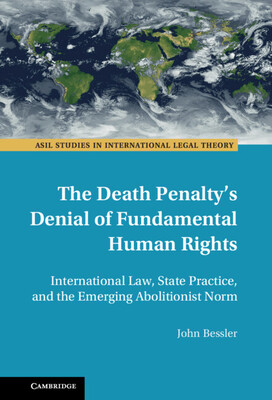
The Death Penalty’s Denial of Fundamental Human Rights: International Law, State Practice, and the Emerging Abolitionist Norm
John Bessler
The Death Penalty's Denial of Fundamental Human Rights details how capital punishment violates universal human rights-to life; to be free from torture and other forms of cruelty; to be treated in a non-arbitrary, non-discriminatory manner; and to dignity. In tracing the evolution of the world's understanding of torture, which now absolutely prohibits physical and psychological torture, the book argues that an immutable characteristic of capital punishment-already outlawed in many countries and American states-is that it makes use of death threats. Mock executions and other credible death threats, in fact, have long been treated as torturous acts. When crime victims are threatened with death and are helpless to prevent their deaths, for example, courts routinely find such threats inflict psychological torture. With simulated executions and non-lethal corporal punishments already prohibited as torturous acts, death sentences and real executions, the book contends, must be classified as torturous acts, too.
-
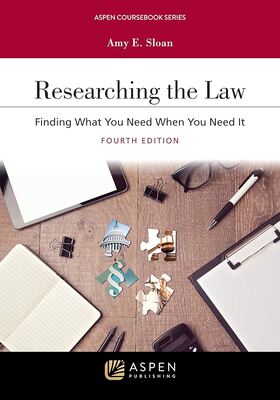
Researching the Law: Finding What You Need When You Need It, Fourth Edition
Amy E. Sloan
Researching the Law: Finding What You Need When You Need It, Fourth Edition guides students through a decidedly contemporary approach to legal research. Widely respected author Amy E. Sloan presents legal research as a process of efficiently filtering a vast quantity of available information. Simply put, students learn how to locate and identify the most pertinent and authoritative information available with the greatest possible expedience. Sloan's clear, concise explanations of essential research sources are presented in a context that speaks to the way lawyers do research today, with a flexible approach that works in a rapidly changing research environment.
-
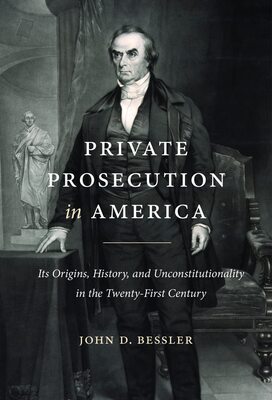
Private Prosecution in America
John Bessler
Private Prosecution in America is the first comprehensive examination of a practice that dates back to the colonial era. Tracking its origins to medieval times and the English common law, the book shows how "private prosecutors" were once a mainstay of early American criminal procedure. Private prosecutors—acting on their own behalf, as next of kin, or through retained counsel—initiated prosecutions, presented evidence in court, and sought the punishment of offenders.
Until the rise and professionalization of public prosecutors' offices, private prosecutors played a major role in the criminal justice system, including in capital cases. After conducting a 50-state survey and recounting how some locales still allow private prosecutions by interested parties, the book argues that such prosecutions violate defendants' constitutional rights and should be outlawed.
-
Uncounted
Gilda R. Daniels
An answer to the assault on voting rights—crucial reading in light of the 2020 presidential election
The Voting Rights Act of 1965 is considered one of the most effective pieces of legislation the United States has ever passed. It enfranchised hundreds of thousands of voters, particularly in the American South, and drew attention to the problem of voter suppression. Yet in recent years there has been a continuous assault on access to the ballot box in the form of stricter voter ID requirements, meritless claims of rigged elections, and baseless accusations of voter fraud. In the past these efforts were aimed at eliminating African American voters from the rolls, and today, new laws seek to eliminate voters of color, the poor, and the elderly, groups that historically vote for the Democratic Party.
Uncounted examines the phenomenon of disenfranchisement through the lens of history, race, law, and the democratic process. Gilda R. Daniels, who served as Deputy Chief in the United States Department of Justice Civil Rights Division and has more than two decades of voting rights experience, argues that voter suppression works in cycles, constantly adapting and finding new ways to hinder access for an exponentially growing minority population. She warns that a premeditated strategy of restrictive laws and deceptive practices has taken root and is eroding the very basis of American democracy—the right to vote!
-
Basic Legal Research: Tools & Strategies, Eighth Edition
Amy E. Sloan
This best-selling coursebook on legal research is known for its clear, step-by-step instruction in the basics. Using a building-block approach, Basic Legal Research: Tools and Strategies, Eighth Edition breaks material into discrete, readily comprehensible parts. Ideal as a course book or reference, this text emphasizes online research, with targeted coverage of print materials. Its comprehensive coverage and self-contained chapters offer flexibility to fit a variety of course structures. Useful pedagogy throughout the text includes end-of-chapter checklists, clear examples, and summary charts. Helpful sample pages and examples of research sources guide students through the presentation, and an accompanying workbook provides exercises to test comprehension and to apply legal research tools and strategies.
New to the Eighth Edition:
- Completely revised material throughout, providing thorough instruction in the latest features and functions of the main research platforms.
- Updated coverage includes Westlaw, Lexis, and Bloomberg Law.
- Instruction now fully oriented toward online research:
- Early chapters address online search strategies and use sample searches to illustrate how to draft a word search.
- Chapters on individual sources focus primarily on online search techniques while still incorporating targeted descriptions of print sources.
- Citation explanations cover both the ALWD Guide to Legal Citation (7th ed.) and the Bluebook (21st ed.).
- New material on citation literacy explains how citation formats communicate weight of authority.
-
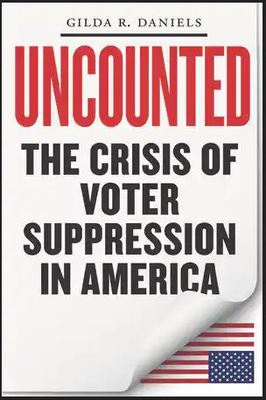
Uncounted: The Crisis of Voter Suppression in America
Gilda R. Daniels
An answer to the assault on voting rights—crucial reading in advance of the 2020 presidential election
The Voting Rights Act of 1965 is considered one of the most effective pieces of legislation the United States has ever passed. It enfranchised hundreds of thousands of voters, particularly in the American South, and drew attention to the problem of voter suppression. Yet in recent years there has been a continuous assault on access to the ballot box in the form of stricter voter ID requirements, meritless claims of rigged elections, and baseless accusations of voter fraud. In the past these efforts were aimed at eliminating African American voters from the rolls, and today, new laws seek to eliminate voters of color, the poor, and the elderly, groups that historically vote for the Democratic Party.
Uncounted examines the phenomenon of disenfranchisement through the lens of history, race, law, and the democratic process. Gilda R. Daniels, who served as Deputy Chief in the United States Department of Justice Civil Rights Division and more than two decades of voting rights experience, argues that voter suppression works in cycles, constantly adapting and finding new ways to hinder access for an exponentially growing minority population. She warns that a premeditated strategy of restrictive laws and deceptive practices has taken root and is eroding the very basis of American democracy—the right to vote! -

Ethical Problems in the Practice of Law, Fifth Edition
Lisa Lerman, Philip G. Schrag, and Robert Rubinson
This problem-based book reflects the authors’ broad range of teaching, clinical, and policy-making experience. Ethical Problems in the Practice of Law’s carefully crafted ethical problems challenge students to engage in a deep analysis and participate in lively class discussion.
-
Understanding Taxation of Business Entities, Second Edition
Walter D. Schwidetzky and Fred B. Brown
Understanding Taxation of Business Entities, from the Understanding Series, is now in its second edition. This book is designed primarily for use by law students taking a course on the taxation of business entities, or separate courses on partnership taxation and corporate taxation. It can be used as a supplemental text. But now it includes both a problem set and a teacher s manual, so it can be used as the main text for any of the three courses.
The book is broken into parts on partnership taxation, C corporation taxation, and S corporation taxation. Each chapter contains a basic overview and a detailed discussion; this allows for an understanding of the big picture before diving into the details, and the basic overview alone may be sufficient for some introductory topics in taxation courses. For each type of business tax entity, the book covers its life cycle formation, operations, and liquidation along with reorganizations and divisions. The book is full of descriptions and analyses of the relevant Internal Revenue Code and Treasury Regulations provisions, summaries of leading cases and IRS rulings, and plenty of examples that apply the law to hypothetical situations.
Understanding Taxation of Business Entities is designed primarily for law students, but it is also intended to be useful to practitioners, including generalists who need a relatively brief summary of a business entity tax topic, beginning lawyers who intend to specialize in partnership and corporate taxation or are working on an LL.M. in taxation, and experienced lawyers who wish to expand their practices into business entity taxation. The book would be similarly useful to accountants who are pursuing a master of science in taxation, as well as accountants practicing in the area of business entity taxation.
-
Researching the Law: Finding What You Need When You Need It, Third Edition
Amy E. Sloan
Researching the Law: Finding What You Need When You Need It, Third Edition, guides students through a decidedly contemporary approach to legal research. Widely respected author Amy E. Sloan presents legal research as a process of efficiently filtering a vast quantity of available information. Simply put, students learn how to locate and identify the most pertinent and authoritative information available with the greatest possible expedience. Sloan's clear, concise explanations of essential research sources are presented in a context that speaks to the way lawyers do research today, with a flexible approach that works in a rapidly changing research environment. Part I explains how to define a research question; pre-filter content before beginning a search; conduct research using a variety of search techniques; and establish post-search criteria for filtering results. Part II describes essential features of individual sources of authority and search strategies unique to each source. Part III contains research flowcharts to help students plan research strategy for different types of research projects.
-
Basic Legal Research Workbook Revised, Fifth Edition
Amy E. Sloan, Steven D. Schwinn, and John D. Edwards
With a balance of online and traditional print sources, the Fifth Edition of BASIC LEGAL RESEARCH WORKBOOK encourages independent, experiential learning. Proven effective in the classroom, the authors’ carefully developed problems gradually progress from introductory to more complex. Whether accompanying Amy Sloan’s BASIC LEGAL RESEARCH: TOOLS AND STRATEGIES, or any other legal research text, these exercises provide hands-on practice throughout the course that will serve students well in their careers as lawyers.
Hallmarks of Basic Legal Research Workbook:
- Coverage that mirrors the research sources studied in first-year Legal Research courses, including both online and print sources
- A logical and intuitive organization • Research exercises presented at graduated levels of difficulty, from guided research to open research requiring more advanced research skills
- Online research exercises with progressively more complex questions to instruct students on the latest interface features of commonly-used databases
- Print assignments that can work in multiple jurisdictions, reducing the demand on single library sources
- Companion website: www.aspenlawschool.com/books/sloan_workbook
Building on its strengths, the timely Fifth Edition includes:
- Flexible exercises that can be completed online or in print • Updated problem sets
- Inclusion of Student Learning Outcomes that support formative and summative student assessment
- Updated exercises that reflect the latest versions of Westlaw and Lexis
- Questions that introduce students to Bloomberg Law and the latest government websites (e.g., govinfo.gov)
Hallmarks of Basic Legal Research Workbook:
- Coverage that mirrors the research sources studied in first-year Legal Research courses, including both print and electronic sources
- A logical and intuitive organization
- Library exercises, presented at graduating levels of difficulty, from basic searches to those requiring more advanced research skills
- Print assignments that can work in multiple jurisdictions, reducing the demand on single library sources
Building on its strengths, the timely Revised Fourth Edition includes updated electronic research exercises that progressively instruct students on the latest interface features from WestlawNext and Lexis Advance.
-
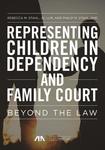
Representing Children in Dependency and Family Court: Beyond the Law
Rebecca Stahl and Philip M. Stahl
Representing Children in Dependency and Family Court: Beyond the Law is a unique family law resource that focuses on the real-world issues that are central for working with child clients in dependency and family court settings. The authors – a board-certified psychologist who has worked with children since the mid-1980s, and an attorney who almost exclusively represents children in dependency court matters – recognize that professionals who represent children in these settings must understand all aspects of the case: the children themselves, the system in which they are engaged, the services available to them, the schools they attend, their ethnic and cultural issues, their special needs, the legal issues they face outside of family and juvenile courts, and more. In addition, lawyers need to take into account the diverse issues faced by the parents with whom they live. While some children's representatives work exclusively in this area and want to delve more deeply into the issues of family dynamics examined in this book, this is also a useful resource for those who work with children's cases less frequently or are just beginning in the area and have had limited or no exposure to these issues. This clearly written and logical guide is an informed resource accessible to professionals at any level of experience.
-
The Value and Purpose of Law: Essays in Honor of M. N. S. Sellers
Colin Starger and Joshua Kassner
This book reveals and discusses the foundations of law and justice. Fifteen leading lawyers and philosophers of law, representing thirteen nations and fifteen different philosophical schools examine the value and purpose of law, and the nature and requirements of law and justice. Some of the world's most learned and provocative legal scholars address the ultimate questions of legal and social philosophy from all angles and the broadest possible perspective, with special reference to the work of Mortimer Newlin Stead Sellers, and the republican, liberal, and analytical schools of legal thought.
The conclusions reached here are not fully unanimous, congruent or conclusive, but they represent the pinnacle of legal scholarship as it exists today and furnish the necessary basis for any future study of law, justice, or the ultimate requirements of just, effective and legitimate law and society.
-
Plain English for Lawyers, Sixth Edition
Richard C. Wydick and Amy E. Sloan
Plain English for Lawyers has been a favorite of law students, legal writing teachers, lawyers, and judges for almost 40 years. The sixth edition, now co-authored by Amy Sloan, updates this classic text, including new chapter exercises, while preserving all the approaches that make it such a standard in the field. It remains (in size only!) a little book, small enough and palatable enough not to intimidate over-loaded law students.
-
Basic Legal Research: Tools and Strategies, Seventh Edition
Amy E. Sloan
Basic Legal Research: Tools and Strategies, Seventh Edition by Amy E. Sloan is known for its clear, step-by-step instruction in the basics. Using a building-block approach, the textbook breaks material into discrete, readily comprehensible parts. Self-contained chapters on sources make the book flexible for any type of legal research course. Useful pedagogy throughout the text includes end-of-chapter checklists, clear examples, and summary charts. Helpful sample pages and examples of research sources guide students through the presentation.
-
The Death Penalty as Torture: From the Dark Ages to Abolition
John Bessler
During the Dark Ages and the Renaissance, Europe’s monarchs often resorted to torture and executions. The pain inflicted by instruments of torture—from the thumbscrew and the rack to the Inquisition’s tools of torment—was eclipsed only by horrific methods of execution, from breaking on the wheel and crucifixion to drawing and quartering and burning at the stake. The English “Bloody Code” made more than 200 crimes punishable by death, and judicial torture—expressly authorized by law and used to extract confessions—permeated continental European legal systems. Judges regularly imposed death sentences and other harsh corporal punishments, from the stocks and the pillory, to branding and ear cropping, to lashes at public whipping posts.
In the Enlightenment, jurists and writers questioned the efficacy of torture and capital punishment. In 1764, the Italian philosopher Cesare Beccaria—the father of the world’s anti–death penalty movement—condemned both practices. And Montesquieu, like Beccaria and others, concluded that any punishment that goes beyond absolute necessity is tyrannical. Traditionally, torture and executions have been viewed in separate legal silos, with countries renouncing acts of torture while simultaneously using capital punishment. The UN Convention Against Torture strictly prohibits physical or psychological torture; not even war or threat of war can be invoked to justify it. But under the guise of “lawful sanctions,” some countries continue to carry out executions even though they bear the indicia of torture.
In The Death Penalty as Torture, Prof. John Bessler argues that death sentences and executions are medieval relics. In a world in which “mock” or simulated executions, as well as a host of other non-lethal acts, are already considered to be torturous, he contends that death sentences and executions should be classified under the rubric of torture. Unlike in the Middle Ages, penitentiaries—one of the products of the Enlightenment—now exist throughout the globe to house violent offenders. With the rise of life without parole sentences, and with more than four of five nations no longer using executions, The Death Penalty as Torture calls for the recognition of a peremptory, international law norm against the death penalty’s use.
-
Lawyers, Clients & Narrative: A Framework for Law Students and Practitioners
Carolyn Grose and Margaret E. Johnson
This book is a new primary text for use by the full panoply of experiential courses, including clinical, externship, legal writing, practical, interviewing, negotiation, counseling, and trial/appellate advocacy. Using multimedia examples, including the podcast Serial, as well as exercises drawn from actual lawyering situations, this book describes, explores, and analyzes narrative as a pedagogy of lawyering. The book addresses the broad spectrum of skills and practice areas and fora that the profession increasingly demands.
This is a comprehensive book for using narrative, stories, and storytelling to develop more fully and effectively as a lawyer. The book provides the theory and information for planning for, conducting, and reflecting on various lawyering activities. In addition, the authors make the teaching relatable and transferable to a variety of contexts by using concrete examples drawn from their own extensive practice, writing, and teaching using lawyering and narrative.
-
Defending Truth: The Quest for Honesty about Jews and Israel
Kenneth Lasson
The quest for truth has long been central to Western civilization and the academic enterprise, a prerequisite for honest discourse about ethics, law, and social order. So too have the problems and paradoxes of antisemitism persisted through the ages – as has the notion that they are endemic to the human condition and have been around for so long it is fruitless to fight them. But the countervailing urge to understand and explain the scourge of racial hatred and anti-Zionism, as well as the conviction that they can be substantially eradicated by sowing truth and honesty, likewise remains strong among freedom-loving people everywhere. DEFENDING TRUTH focuses on three areas that reflect the demonization of Jews and Israel over the past century: the continuing phenomenon of Holocaust denial, entrenched media bias in Mideast reporting, and the current worldwide effort to impose boycotts, divestment, and sanctions against Israeli academic, business, and state enterprises. By describing in detail the use of Big Lies and purposeful distortions to accomplish those ends, this book engages the difficult but necessary pursuit of an answer to the eternal query, how best can Truth be defended?
Printing is not supported at the primary Gallery Thumbnail page. Please first navigate to a specific Image before printing.